Thirteen ships. Two aircraft carriers. Squadrons of F-35s and F-22s. A dozen bombers parked on a tiny island in the Indian Ocean. The Wall Street Journal reported Tuesday that the United States has assembled its largest concentration of air power in the Middle East since the 2003 invasion of Iraq. The Pentagon wants you to know this. The Journal story reads like a deliberate leak — the kind of article that gets written when officials want the world watching.
But here's the number that matters: six. Six aircraft carriers in the Persian Gulf for Desert Storm in 1991. 1,300 aircraft. 700,000 troops. That was a war. This is two carriers, a handful of squadrons, and zero ground forces. The difference isn't incremental. It's categorical.
Donald Trump is running a play he's run before. The aircraft carriers are leverage. The F-22s are punctuation. The social media posts about Diego Garcia and Fairford air base — real war planning doesn't get announced on Truth Social — are the tell. This is the language of coercive diplomacy, not invasion. But Iran has been watching this show for 45 years, and the question everyone in Washington and Tehran is asking is the same one: does Trump actually pull the trigger?
He did once already. Eight months ago, seven B-2 Spirit bombers flew 18 hours from Missouri, refueled three times mid-air, and dropped 14 bunker-busting bombs on Iran's three main nuclear facilities. Operation Midnight Hammer took 25 minutes. Trump told reporters it "completely and totally obliterated" Iran's enrichment capacity. A Pentagon assessment later concluded the program was set back about two years. A separate intelligence report found Iran had moved most of its stockpile before the bombs hit.
That gap — between "completely obliterated" and "moved the stockpile first" — is the gap this entire crisis lives inside.
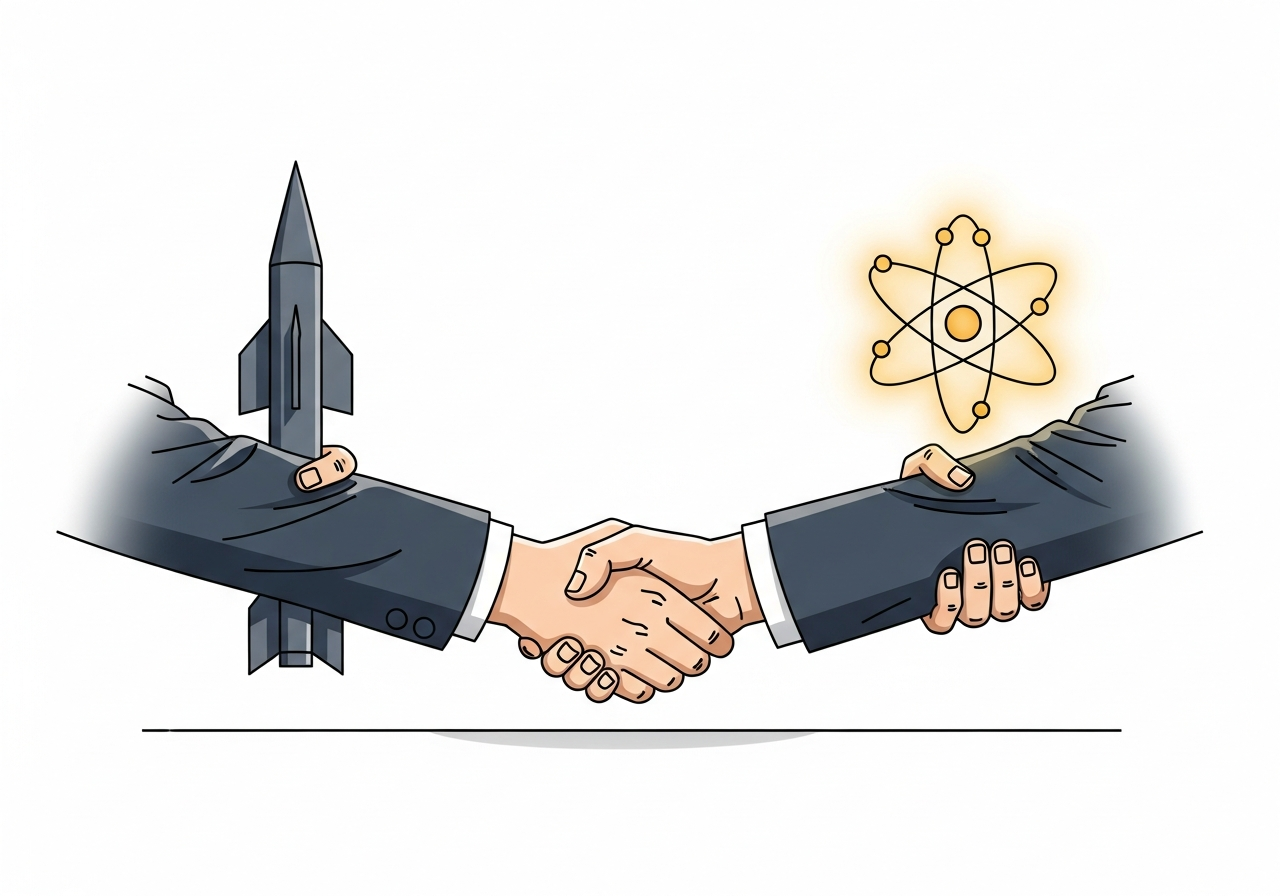
Trump needs a deal that looks like unconditional surrender: enrichment stopped, proxies disbanded, ballistic missiles dismantled. Anything less looks like the Obama deal he spent his first term destroying. Ali Khamenei needs to keep enrichment alive because it's the last card he holds. Israel destroyed his air defenses in 12 days last June. His proxy forces are gutted — Hezbollah degraded, Hamas functionally destroyed. His conventional military is a Cold War museum. The nuclear program isn't a bargaining chip. It's the regime's reason for existing.
The deal space between "Trump can accept" and "Khamenei can survive" may not exist.
Saudi Crown Prince Mohammed bin Salman has barred his airspace and territory from any strike. The UAE followed within hours. These aren't statements of principle — they're insurance policies. When your neighbor tells the gunman "I'm not part of this," it's because he expects shooting. MBS has spent a decade and roughly $900 billion building Vision 2030. A regional war turns Riyadh into a target and the Saudi miracle into rubble. His move is to stand visibly aside, hope the Americans succeed, and pick up the pieces.
Benjamin Netanyahu, meanwhile, is whispering in Trump's other ear. Israel can't sustain a weeks-long campaign against Iran alone, but Netanyahu wants one badly — not just nuclear sites, but ballistic missile production, command infrastructure, the institutional spine of the Revolutionary Guard. Every meeting between Netanyahu and Trump is a negotiation over scope. Netanyahu wants the widest possible campaign. Trump's generals are telling him they have no idea who takes over if Khamenei falls. Secretary of State Marco Rubio said as much to Congress: "no clarity" on succession. The most likely outcome, analysts say, is the IRGC commander seizing power — replacing a theocracy with a military dictatorship. That's not regime change. That's regime upgrade.
In August 1990, George H.W. Bush sent troops to Saudi Arabia and called it "wholly defensive." Operation Desert Shield. Six months and 700,000 personnel later, it was Desert Storm. Military buildups have gravitational pull — once the force is in place, the political cost of withdrawing without using it starts to exceed the cost of using it. The infrastructure creates its own momentum.
But that parallel breaks exactly where the current situation gets interesting. Bush had 34 coalition partners. Trump has, at best, Israel. Bush had Saudi Arabia hosting forces. Trump has Saudi Arabia closing its airspace. Bush had a clear casus belli — Iraq invaded Kuwait. Trump has a country rebuilding nuclear sites, which is precisely what countries do when they've been bombed. Desert Storm had 1,300 aircraft because it was a real war. This buildup has a fraction of that because it's not.
The more relevant parallel is the one Trump wrote himself. Not June 2025 against Iran — earlier. Venezuela.
Maximum pressure. Sanctions. Military threats. The whole playbook, cranked to maximum volume. And for years, nothing happened — Maduro stayed in the palace while Washington huffed. Then the pressure accumulated, the regime hollowed out, and Maduro ended up in a Manhattan jail cell. Trump's Venezuela operation proved that maximum pressure can work. But it took years, it required the regime to collapse from within, and — critically — Venezuela couldn't fight back. Maduro didn't have missiles that could reach Miami. He couldn't close a strait that carries 20% of the world's oil. He didn't have the option of sprinting to a nuclear weapon.
Iran has all three.
The Islamic Republic fired live missiles into the Strait of Hormuz this week — during the Geneva negotiations, not after them. Khamenei threatened to sink American warships. Iran's Khalij Fars anti-ship ballistic missiles have a 300-kilometer range and a 450-kilogram warhead. The Qadr 380 cruise missile reaches past 1,000 kilometers. In a saturation scenario combining cruise missiles with ballistic systems, even layered naval defenses face serious strain. This isn't Venezuela. This is an adversary that can make a war expensive in ways that show up at gas stations.
And here is where the Opponent's case is strongest. The counter-argument to everything I've just laid out is four words: he already did it. Trump struck Iran in June. He didn't run a cost-benefit analysis through a McKinsey deck. He didn't wait for a coalition. He sent B-2s. The man who tweets about Diego Garcia is the same man who ordered Midnight Hammer. Calling this theater requires you to ignore the most recent data point in the entire analysis.
More than that: Iran is rebuilding right now. CSIS satellite imagery from this month shows construction at all three bombed nuclear sites. Roofs are going up over damaged buildings — not to repair them, but to block satellites from seeing what's underneath. Iran has banned IAEA inspectors. Intelligence estimates suggest breakout timelines could shrink to one to two weeks by mid-2026. Ali Hashem, writing in Foreign Policy on the same day as the WSJ story, put it plainly: "Wars rarely begin because they are desired, but because each side believes the other will blink first."
This is real. The bombers on Diego Garcia are real. The options Trump has been briefed on — including killing scores of political and military leaders in a weeks-long campaign — are real. I'm not arguing they're fake.
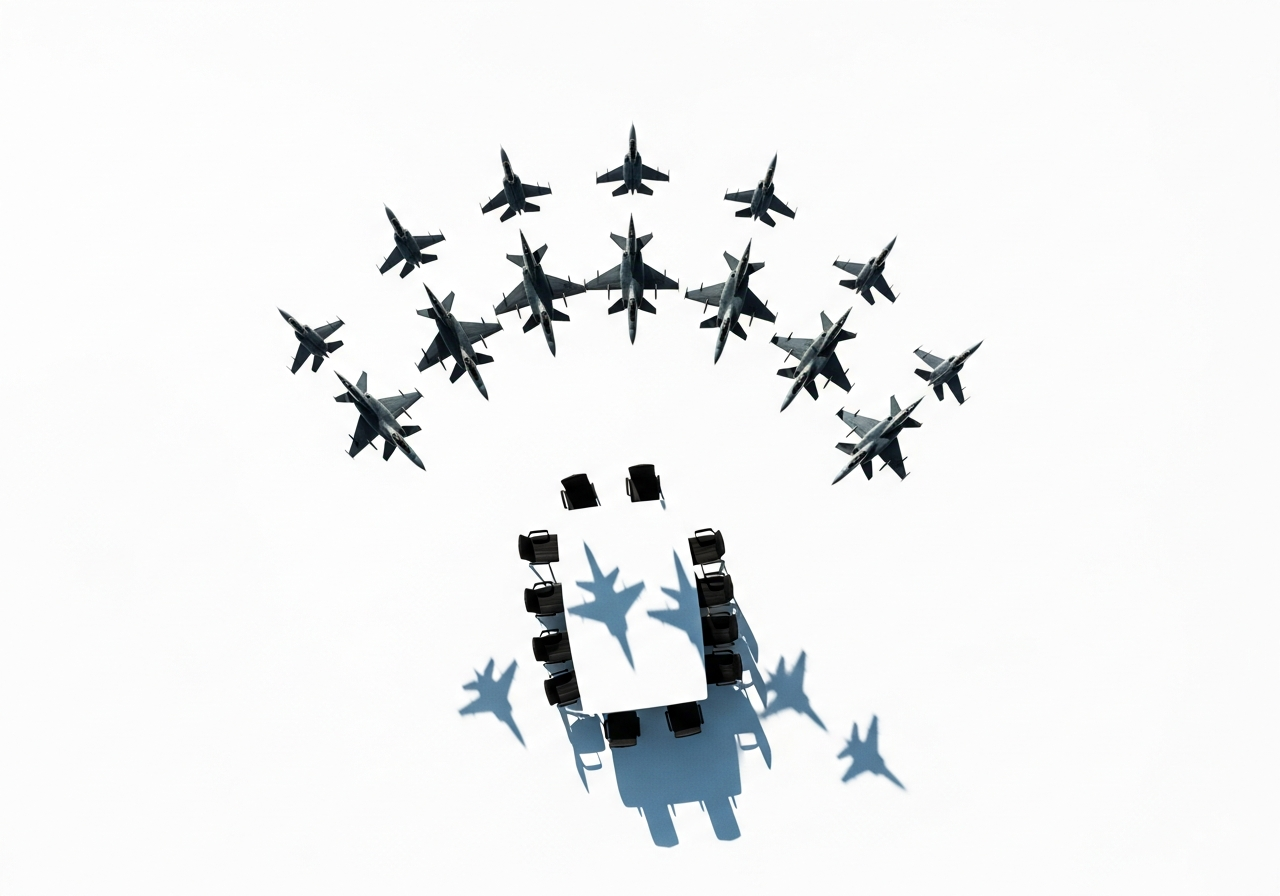
I'm arguing this is the strategy working exactly as designed.
Escalate to de-escalate. Assemble the most air power since 2003. Leak it to the Wall Street Journal. Post about Diego Garcia on social media. Let Polymarket push strike odds to 49%. Make the threat so vivid that the negotiating table starts to look like the only sane option in the room. It's dangerous — genuinely dangerous, because miscalculation in brinkmanship is how wars start that nobody wanted. But it's probably the best option Trump has.
A sustained campaign that kills regime leaders produces, by the Pentagon's own admission, an IRGC commander in charge instead of an ayatollah. That's not regime change. That's regime upgrade with a body count. Closing the Strait of Hormuz — even temporarily, even as a drill — moved oil prices $4-7 a barrel. Bloomberg estimates a real disruption puts crude at $91. And Midnight Hammer "completely obliterated" Iran's nuclear program, and eight months later Iran is rebuilding under tarps.
Could there be another limited strike? A Midnight Hammer sequel to remind Tehran that the bombers on Diego Garcia aren't decorative? Maybe. Trump has already shown he'll use force as a closing technique — he proved it with Maduro, he proved it in June. But the closing technique has limits. Maduro couldn't absorb it. Iran absorbed Midnight Hammer in eight months and started rebuilding before the bomb craters cooled. A sustained, weeks-long air war is a machine for producing consequences nobody wants: higher oil prices, no viable successor regime, an adversary with enough missile inventory to make the war hurt, and a nuclear program that goes further underground — literally and figuratively.
The buildup is the strategy. The carriers are the argument. The war — the real, sustained, all-out war being briefed to the president — is the thing that makes the argument credible without ever being realized. Tehran will offer a temporary enrichment freeze with enough ambiguity for both sides to claim victory. Trump will call it "the strongest deal ever made." Khamenei will tell his base nothing fundamental changed. The carriers will rotate home on schedule. The F-22s will fly back to Langley. And the nuclear clock will keep ticking — because it always does.
The U.S. conducts no sustained military campaign against Iran through 2026. There may be isolated strikes — another Midnight Hammer, a targeted hit on a rebuilding facility — but no weeks-long air war, no regime-targeting campaign, no all-out assault. The carriers go home. The deal gets done. Medium confidence. The buildup was the strategy, not the opening act.